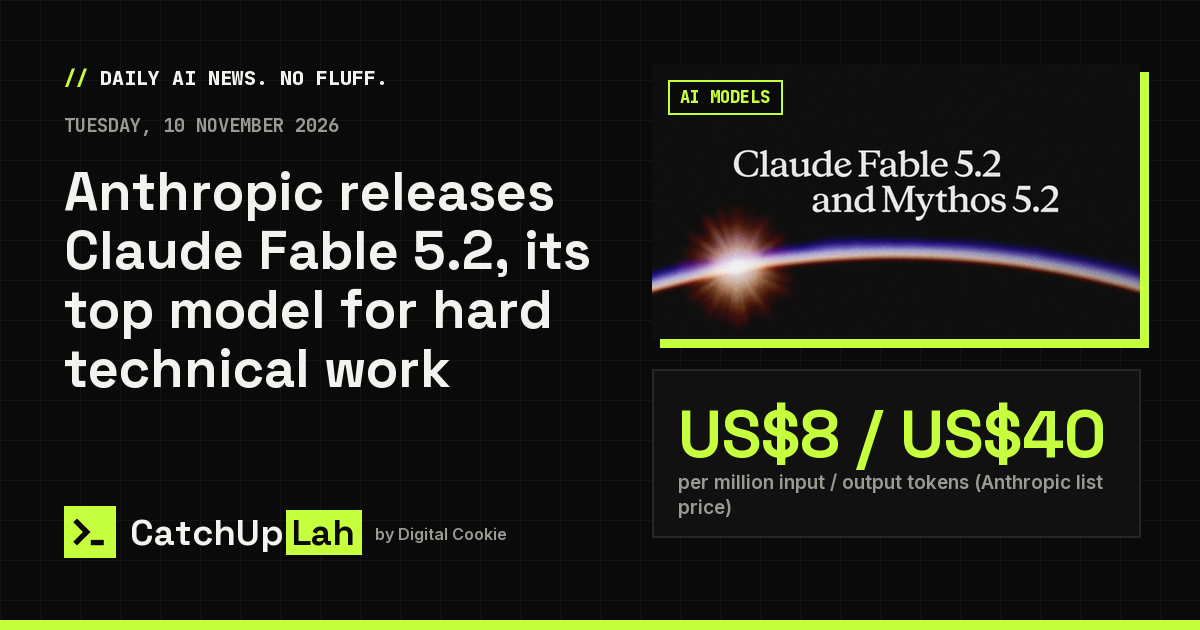

















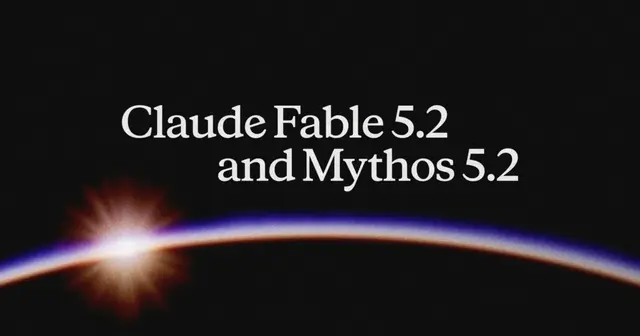
On 9 November (US time) Anthropic released Claude Fable 5.2 and a restricted sibling, Mythos 5.2. Anthropic says Fable 5.2 is available on all its platforms, including Amazon Bedrock An Amazon Web Services product that lets companies use many different AI models, and build AI agents, through one service., at US$8 per million input Token efficiency How much of your usage allowance an AI spends to do the same job. AI tools read and write text in small chunks called tokens, and usage limits are often counted this way. and US$40 per million output tokens. Most performance figures below are Anthropic's own.
Key points
- Anthropic's own Benchmark A standard test used to compare AI models, like an exam everyone takes so scores can be compared. table puts Fable 5.2 ahead of its everyday model, Opus 5.5, on most tests, for example 69.9% vs 62.3% on the FrontierSWE v2 coding test. These are company-run tests; we found no independent results yet.
- Anthropic itself still recommends starting with Opus 5.5 for most coding and knowledge work, and moving up to Fable only for the hardest open-ended jobs. Fable blocks most cybersecurity and research-biology tasks; those requests are answered by older models instead. Mythos 5.2 is only for approved cyber and life-sciences programmes.
- Entrepreneurship professor Ethan Mollick, who tested it before launch and says he takes no money from AI labs, found it impressive at coding, research and business planning. But he says it did not notice problems in its own work, and he would not let it contact real customers unsupervised.
- What hands-on testers found (reviewers' impressions, not benchmarks): Claire Vo on How I AI (https://www.youtube.com/watch?v=1gYQc4CL_oo) said Fable 5.2 felt fast and creative and much less annoying to work with than earlier Fable, but weak at web and front-end design taste when left alone. Peter Yang (https://www.youtube.com/watch?v=SsSKJA0EHD4) ran five real-use tests against Opus 5.5 and also found Fable stronger on polish for video, games and bold redesigns, yet Opus still held its ground better when he pushed back hard. Both still treat Opus as the everyday default for many tasks.
- For businesses: Fable 5.2 is a 'Covered Model'. Anthropic says other customers' data is kept up to 30 days for safety monitoring unless an eligible enterprise uses Zero data retention An arrangement where an AI provider does not store your prompts and answers after replying, usually offered only to eligible business customers.; AWS says Bedrock use includes human safety Code review Checking code someone (or an AI) wrote before it goes live, to catch bugs and risky changes.. Paid plans that include Fable get one to three extra Fable usage resets at launch.
Why it matters: If you already pay for Claude, the launch resets are a cheap chance to try Fable on one genuinely hard task and compare it with Opus 5.5. Before sending business data, check the retention terms with your administrator.
Sources (5)
- Introducing Claude Fable 5.2 and Claude Mythos 5.2 · Anthropic
- Introducing Claude Fable 5.2 on AWS · AWS Machine Learning Blog
- Fable 5.2 and Jagged AGI · One Useful Thing (Ethan Mollick)
- Claude Fable 5.2 review: fast, creative, and finally not annoying · How I AI
- I Tested Fable 5.2 vs Opus 5.5 on 5 Real Use Cases · Peter Yang