1Highlight: OpenAI's GPT-6.2 Astra and Sol aim to do more work per token, with Astra's API price cut 20%.
2Malaysia: approved data centre investment jumped 44.5% to RM123.5 billion in nine months, MIDA says.
3Also: Gemini's free Tasks agent, Genesis AI's RM2 billion bet on robot hands, and seven habits of AI-native companies.
Highlight of the day
Models
20%
lower API prices for GPT-6.2 Astra than GPT-6 Astra (OpenAI)
Merged from 2 sources
★ Highlight of the day
OpenAI's GPT-6.2 models promise more work per token and cheaper API
OpenAI released GPT-6.2 Astra, its model for the hardest work, and GPT-6.2 Sol, a cheaper everyday model, on 17 November (US time). Both are in ChatGPT Work and Codex OpenAI's coding agent that can write, change and test software from written instructions. on Plus, Pro, Enterprise and Edu plans, and in the API Application programming interface: a door that lets one piece of software ask another for data or actions.. OpenAI's main promise is that they finish demanding tasks with fewer output Token A small chunk of text, roughly part of a word, that AI models read and write; AI usage and pricing are counted in tokens., so your Rate limit A cap on how many requests or messages you can send to an AI service in a set amount of time. lasts longer.
What we learned
Prices: in the API, GPT-6.2 Astra costs 20% less than GPT-6 Astra, at about RM33 (US$8) per million input tokens, RM1.64 (US$0.40) for Caching Saving text the AI has already read so it can be reread cheaply instead of paying full price every time. input and RM164 (US$40) for output. GPT-6.2 Sol keeps GPT-6.1 Sol's prices (OpenAI; RM at about RM4.09 per US$, the rate TechNode Global used for MIDA's figures).
OpenAI's own test results, so treat them as vendor claims: on AI agent An AI program that can take actions for you, like writing code, filling forms or moving items, not just answering questions.' Last Exam, a test of multistep professional work, Astra scores 5.2 points higher than GPT-6 Astra at under a third of the cost. On Cognition's FrontierCode 2.0, Sol comes within 0.5 points of Astra at about one-fifth of the cost, both at Reasoning effort A setting that controls how long an AI model thinks before answering; higher effort can improve hard answers but costs more time and tokens..
For office work, OpenAI says Astra follows your Database template A ready-made starting page in a Notion database. Each new row created from it gets the same layout, text and views. more closely. Give it a screenshot of one slide and it can match the layout, colours and font size for the rest of the deck (9to5Mac). Accounting startup Basis, quoted by OpenAI, says its long accounting jobs took 50% less time.
Ultrafast mode An OpenAI setting that makes a model write its answer up to several times faster, in exchange for using more of your plan's allowance. generates text up to 4.5 times faster but uses more of your allowance. It comes with Sol on the US$200 (about RM820) Pro plan, on both models on the US$500 (about RM2,050) Pro plan, and in Enterprise and Edu Workspace In Notion, a workspace is a team's shared space: the account that holds its pages, databases and members. once an admin turns it on.
Why it matters: For most users the real change is getting more done before hitting a limit, but the scores are OpenAI's own, so test GPT-6.2 on your usual tasks before switching. If you pay for the API, re-check your Astra costs now that prices are 20% lower.
OpenAI upgrades ChatGPT and Codex with new GPT-6.2 Astra and Sol models · 9to5MacRead ↗
Was this useful?Tap to vote. Hold, right-click or press Shift+Enter to add a reason or a note first.
More stories today
Malaysia & ASEAN
RM123.5bn
approved data centre and cloud investment, Jan-Sep 2026 (MIDA)
Merged from 4 sources
Malaysia & ASEAN
Malaysia's approved data centre investment jumps 44.5% despite US chip curbs
The Malaysian Investment Development Authority (MIDA) said on 17 November that Data centre A large building full of computers that store data and run online services and AI, and that uses a lot of power and water. and Cloud computing Renting computers in someone else's data centre over the internet instead of buying your own. projects drew RM123.5 billion (about US$30.2 billion) in Approved investment An investment a government agency has signed off on; it shows planned spending, not money already spent or buildings already finished. from January to September 2026, across 86 projects. That is 44.5% more than a year earlier. The same day, Economy Minister Akmal Nasrullah Mohd Nasir said the Nvidia and Megaspeed scandal has not changed Malaysia's chip and AI plans.
Key learnings
Data centres made up 35.2% of the RM350.4 billion in total approved investment, up from 29.4% a year earlier. The US was the biggest foreign investor at RM60.0 billion, more than five times its RM11.3 billion in the same period of 2025. Named projects include an AirTrunk expansion and a new Princeton Digital Group campus (MIDA).
New data centres must meet a minimum 30% Local content requirement A rule that a set share of a project's goods, services or work must come from local companies, here at least 30% for new Malaysian data centres. set by the Data Centre Task Force, meant to give Malaysian companies a share of the work (MIDA, The Edge Malaysia).
An approved investment is a commitment, not a finished building. These figures run to September, before the US licence rule for AI chips going to Malaysia was announced on 16 November (US time). Analysts said this week that China-linked projects are the most exposed.
On Megaspeed, MITI says it never approved Megaspeed International or its Malaysian unit Speedmatrix, which rented data centre space and brought in its own servers and AI chips. MITI is working with the Royal Malaysian Customs Department to check whether any chips were Re-export Sending imported goods on to another country instead of using them where they first arrived. (Lowyat.net, citing The Edge Malaysia).
Why it matters: The data centre boom is clear in the approvals; the next numbers to watch are what actually gets built and who rents the space. If your company supplies data centres, the 30% local content rule is your opening.
Malaysia Records RM350.4 Billion in Approved Investments in the First Nine Months of 2026, Up 20.7% · MIDARead ↗
Data centre, cloud computing investments surge 44.5% to RM123.5b in first nine months of 2026 · The Edge MalaysiaRead ↗
Malaysia's data-center and cloud-computing approved investments up 44.5 percent in first nine months of 2026 · TechNode GlobalRead ↗
Economy Minister: NVIDIA Issue Does Not Affect Malaysia's Semiconductor, AI Ambitions · Lowyat.netRead ↗
Was this useful?Tap to vote. Hold, right-click or press Shift+Enter to add a reason or a note first.
Assistants & privacy
2 months
how long Google will keep temporary Gemini chats, up from 72 hours
Merged from 3 sources
Assistants & privacy
Google makes Gemini's task agent free but keeps private chats longer
Google renamed its Spark AI agent An AI program that can take actions for you, like writing code, filling forms or moving items, not just answering questions. 'Tasks' on 17 November (US time) and made it free for Gemini users in the US, Canada, Japan, Korea, Australia and India, running on its Gemini 4 Hydrogen model. The same day, it said Temporary chat A chatbot conversation meant not to be saved in your history; the company may still keep a copy for a set time for safety or legal reasons., and chats made with history turned off, will now be kept for about two months instead of 72 hours.
Key learnings
Flip the switch on Gemini's home screen from Chat to Tasks and it can plan meals, manage your calendar or dig through email for recurring charges you may not need. In the US it can also call businesses to book appointments or check prices and stock, pay with Google Pay, and take tasks by email or text (The Verge, TechCrunch).
Google says each task runs in a hardware-isolated Virtual machine A pretend computer running inside a real one, so software inside it is kept separate from the real machine. used only by your account, and Gemini stops to ask before sensitive steps such as a purchase. Malaysia is not on the launch list.
The retention change rolls out worldwide over the coming weeks. Google says it keeps chats to respond to you, handle feedback and protect its services, and does not use temporary chats for training. For comparison, OpenAI keeps temporary ChatGPT chats for up to 30 days and Anthropic keeps Claude incognito chats for 30 days (TechCrunch).
Chat history and AI training are now separate settings instead of one 'Keep Activity' switch. If you had Keep Activity off, both start off; if it was on, history stays on and you can choose separately whether Google trains on your chats.
Why it matters: Malaysian users cannot use Tasks yet, but the Data retention How long a company keeps your data, such as chat logs, before deleting it. change applies everywhere: a temporary Gemini chat is no longer gone after three days. Check the new training switch in Gemini's settings.
Google's Spark AI agent becomes 'Tasks' - and now it's free · The VergeRead ↗
Google expands access to Gemini Tasks, which can help with calls, purchases · TechCrunchRead ↗
Google to keep Gemini chats for 2 months, up from 72 hours, even with history off · TechCrunchRead ↗
Was this useful?Tap to vote. Hold, right-click or press Shift+Enter to add a reason or a note first.
Robots
30-40
Eno humanoid robots built so far (Genesis, via TechCrunch)
Merged from 2 sources
Robots
Genesis AI raises about RM2 billion to give robots human-like hands
Silicon Valley startup Genesis AI announced a US$500 million (about RM2 billion) funding round on 17 November, led by Khosla Ventures, Premji Invest and Eclipse. Its bet in Physical AI AI that controls machines acting in the real world, such as robots and self-driving vehicles, rather than only producing text or images. is Dexterous manipulation A robot's ability to handle objects skilfully with fingers or grippers, such as picking up small items, folding or peeling a label.: robot hands shaped like ours, trained on data from sensor gloves worn by real Notion Worker A small piece of code that runs on Notion's side, for example to pull data in from another app or prepare data for a custom block..
Key learnings
More than 100 workers around the world wear the gloves and head cameras while they work. The gloves record force, meaning how hard fingers press, which the company says is the key to handling small objects. Its robots wear the same gloves, and it adds millions of simulated runs.
The demo was real but imperfect. TechCrunch watched two robot arms pack, tape and label a box; on a second run the robot fumbled a box and struggled to peel off the label, the kind of gap between lab and daily work the whole industry still has to close.
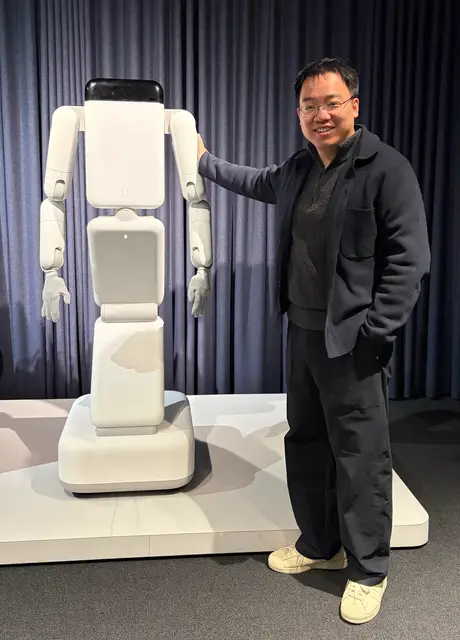
Genesis has built 30 to 40 of its Eno Humanoid robot A robot built roughly in the shape of a person, with arms, a torso and often legs or wheels., is piloting them with a few unnamed customers, and has picked a US contractor to start mass production next year. Its strategy is Vertical integration When one company makes most parts of its product itself, instead of buying them from suppliers; here data, AI model and robot.: it collects its own data, trains its own model and designs its own robot. One weak spot: its hands last only a few weeks of regular work before they need replacing.
Co-founder and CEO Zhou Xian says the model design is only about 10% of the result, and data and training systems matter most: 'We have all the recipes. It's just about execution.'
Why it matters: Hands are the hardest part of making robots useful in shops and warehouses, so this is one to watch. Treat 'cracked dexterous manipulation' as the CEO's claim until customers report results and the hands last longer than a few weeks.
Genesis AI raises $500M to deploy glove-wearing robots · TechCrunchRead ↗
Genesis AI raises $500M to get Eno out of the lab and onto factory floors · HumanoidMegaHubRead ↗
Was this useful?Tap to vote. Hold, right-click or press Shift+Enter to add a reason or a note first.
AI at work
3,600
shared skills in Uber's library, used 30,000+ times a day (as cited on The AI Daily Brief)
AI at work
Seven habits that set AI-native companies apart, from Uber to Shopify
On The AI Daily Brief on 17 November, host Nathaniel Whittemore pulled together what Stripe, Shopify, Uber, Ramp, Cloudflare and others have published about running AI agent An AI program that can take actions for you, like writing code, filling forms or moving items, not just answering questions. at work. His conclusion: the most advanced companies treat agents less like named teammates and more like an on-demand consulting firm.
Key learnings
Give agents the whole picture. Ramp pulls Slack, Notion, Linear and Calendar into agent memory every day, and Uber built a map of Context window How much text an AI can keep in mind at once, like the size of its short-term memory. from more than 30 internal systems. But context goes stale: Ramp found its analyst agent got worse when that context was neglected.
Let events start the work and use one Orchestrator agent A lead AI agent that breaks a job into parts, hands each part to other agents, and combines their results.. A customer message, failed build or new invoice triggers a job, and most Uber agent sessions are now started by other agents. A lead agent splits the job among Sub-agent A helper AI that a main AI agent hands a smaller task to, so the main one stays focused.; Anthropic says this beat a single agent by about 90% on its internal research tests.
Check the work and name an owner. Shopify drops a security finding unless an agent can write a test that proves it, using a different model to check. At Stripe agents write code but a human Code review Checking code someone (or an AI) wrote before it goes live, to catch bugs and risky changes. every merge, Uber traces every agent hand-off back to a person, and Snap says over half of its agent spending goes on Guardrail A fixed safety rule around an AI system that blocks or checks risky actions, such as stopping it from moving money without a person..
Share one system. Ramp has 350 shared workflows and Uber has 3,600 skills used more than 30,000 times a day; Shopify tracks how often changes are undone, not lines of AI code. A warning: a Harvard Business Review study in May found managers checked work less carefully when it came from an 'AI teammate'.
Why it matters: Three habits cost almost nothing to copy: write decisions down where agents can read them, have a different tool check the output, and name the person who owns each result. Most examples come from software teams, where 'done' is easy to test, as Whittemore notes.
 Models